Rebel Crossings by Sheila Rowbotham
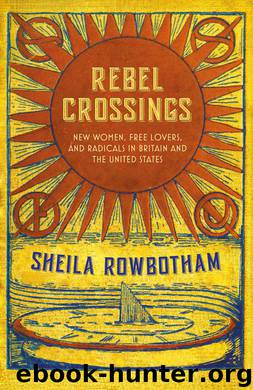
Author:Sheila Rowbotham
Language: eng
Format: epub
Publisher: Verso Books
Opposition to imperialism had made William restless in discussions with small groups, and that autumn he decided to align himself with William Jennings Bryan who had been chosen as the Democratic candidate for the Presidency.75 Early in November, William sat on the platform at a rally for Bryan in Faneuil Hall as a member of the Bryan Club.76 Bryan’s opposition to the bloody suppression of the movement for independence in the Philippines led to his vilification in the press. A movement of Bryanite Democrats, anti-war Republicans and socialists had converged through the Anti-Imperialist League.77 Dressed up in his best clothes and wearing a new hat, William distributed anti-imperialist leaflets and wrote ‘An Appeal to the Working Man’ for Bryan’s campaign. An admiring Helen read it out loud to her distinctly unBryanite parents.78 But it was to no avail; on November 7th a devastated Helen announced in her journal, ‘McKinley re-elected’.79
On November 11th, William returned to familiar political turf, addressing the Boston Anarchist Club on ‘The Chicago Martyrs’. His speech was reported in Free Society, with which James F. Morton was associated. The men accused of the Haymarket bombing were totemic figures for William and outrage over their execution had led him towards anarchism. In the religious idiom common on the left in the period, William linked the executed men symbolically to the sufferings of Christ, the early Christian Martyrs, and to Irish Republicans. All were ‘victims of murder … in the name of law and order’. Thirteen years after their death he depicted their sacrifice as being for ‘broader opportunities, more culture; a chance to live a freer, healthier fuller life’ – his own thwarted longings.80
For William the central state that had judicially murdered the Chicago anarchists could never be benign. The state socialism of the Bellamy Nationalists and the Fabians was anathema to him. However, the bitter politics of Ireland had left him equally opposed to those anarchists who called rhetorically for ‘armed resistance’.81 Instead, William now placed his hopes on the slow accretion of economic reforms. This long-view, sustained by a social evolutionary faith in progress and by a residue of deterministic Marxism, did not go down well with his anarchist comrades at the meeting, still eager for revolution.
By 1900, though absolutely certain about rejecting socialism, William had discovered that he was not in complete affinity with the Boston anarchists. His problem as a left-wing activist was twofold: he tended to dig out ideological problems within every tendency he encountered, yet was ever on the lookout for forms of pragmatic action. William had arrived at an impasse; how were workers to turn the long-term economic changes he predicted to their advantage under the beady eyes of their alert employers? As a businessman, albeit a small and reluctant one, William was well aware that ‘The propertied class’ would ‘forcibly resist any effort to despoil them’.82 Indeed, labouring away over his basket-making accounts over all those years had hardened his own outlook. William took a much tougher line than Helena
Download
This site does not store any files on its server. We only index and link to content provided by other sites. Please contact the content providers to delete copyright contents if any and email us, we'll remove relevant links or contents immediately.
Waking Up in Heaven: A True Story of Brokenness, Heaven, and Life Again by McVea Crystal & Tresniowski Alex(37808)
Empire of the Sikhs by Patwant Singh(23085)
We're Going to Need More Wine by Gabrielle Union(19046)
Hans Sturm: A Soldier's Odyssey on the Eastern Front by Gordon Williamson(18590)
Leonardo da Vinci by Walter Isaacson(13336)
The Radium Girls by Kate Moore(12028)
Tools of Titans by Timothy Ferriss(8395)
Educated by Tara Westover(8054)
How to Be a Bawse: A Guide to Conquering Life by Lilly Singh(7486)
Permanent Record by Edward Snowden(5847)
The Last Black Unicorn by Tiffany Haddish(5635)
The Rise and Fall of Senator Joe McCarthy by James Cross Giblin(5280)
Promise Me, Dad by Joe Biden(5153)
The Wind in My Hair by Masih Alinejad(5095)
A Higher Loyalty: Truth, Lies, and Leadership by James Comey(4963)
The Crown by Robert Lacey(4815)
The Iron Duke by The Iron Duke(4354)
Joan of Arc by Mary Gordon(4110)
Stalin by Stephen Kotkin(3965)
